
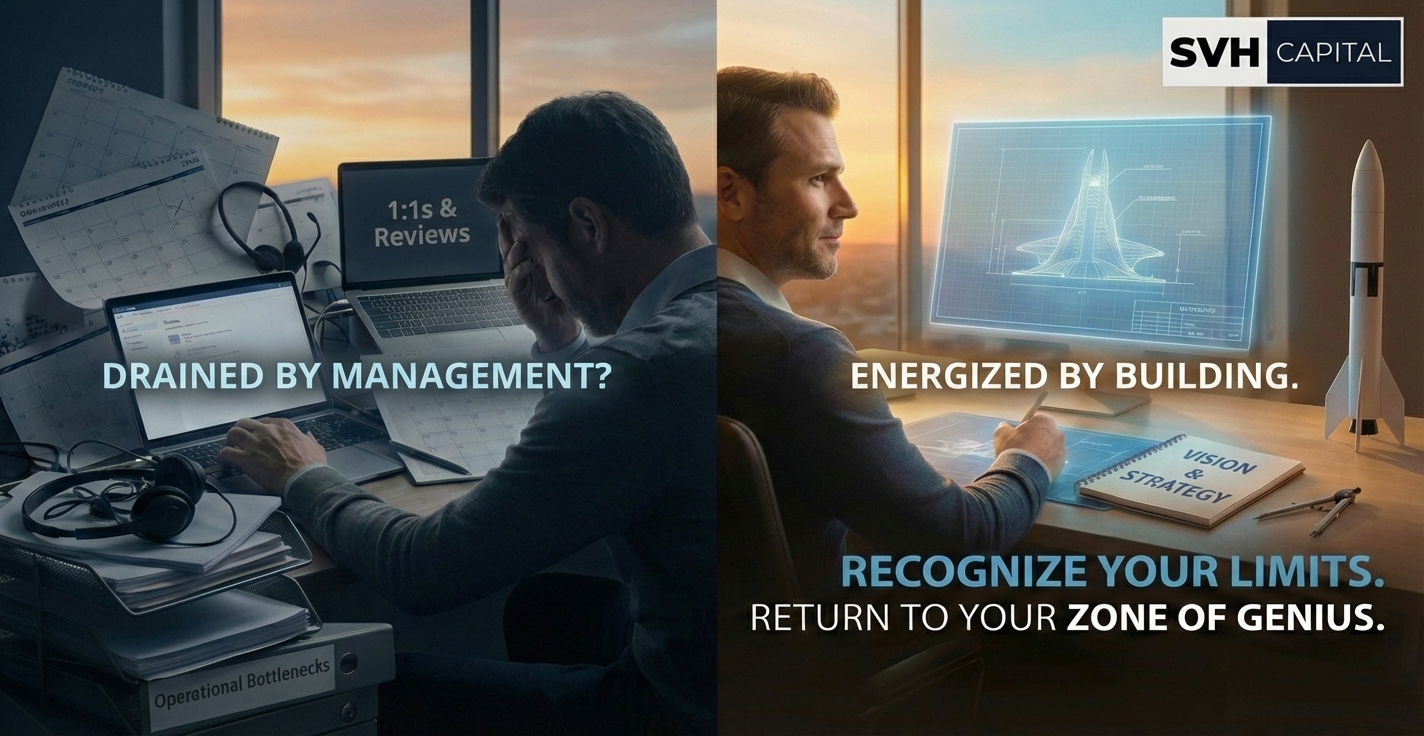
You’ve crossed the $5 million ARR mark. Congratulations! You’ve officially survived the “valley of death” where most startups wither. But lately, the morning coffee doesn’t taste like victory; it tastes like a mounting list of 1:1s, performance reviews, and operational bottlenecks. If you find yourself staring at your calendar and feeling a sense of dread toward the very company you built, you aren’t failing. You’re likely experiencing the classic Founder vs. CEO mindset conflict.
For a business owner at this scale, recognizing this friction isn’t just about your mental health, it’s about the survival of the enterprise.
The Mindset Conflict: Why What Got You Here Won’t Get You There

In the early days, being a “Founder” was an advantage. A Founder is a force of nature: a visionary, a builder, and a relentless problem-solver. You succeeded because you were comfortable with chaos and had your hands in everything from product dev to sales.
However, once you scale past $5M, the business demands a CEO.
- The Founder seeks disruption; The CEO seeks stability.
- The Founder manages ideas; The CEO manages people and processes.
- The Founder works in the business; The CEO works on the business.
The friction occurs when you try to wear both hats simultaneously. You might find yourself diving into a project, changing the direction on a whim because of a creative spark, and then leaving your team to clean up the operational mess. This isn’t leadership; it’s a mindset mismatch that creates a bottleneck at the top.
Hating Management is a Signal, Not a Flaw
Many high-level founders feel a deep, quiet guilt: “I built this empire, so why do I hate running it?”
Let’s be direct: Hating management is a signal that you’ve reached your professional limit in that specific role. It is not a sign of weakness; it’s a sign of specialization.
When your company was at $1M, management was informal. At $5M+, management becomes a discipline of its own. It requires a high degree of emotional labor, repeatable systems, and the patience to watch others do the work (often slower than you would).
If you feel drained by “people problems” and energized by “product problems,” you are living in your Zone of Frustration. Pushing through this burnout doesn’t make you a better leader; it makes you a liability. When a founder is burnt out, the vision gets blurry, and the culture starts to sour.
Returning to Your Zone of Genius
Your Zone of Genius is the intersection of what you are uniquely gifted at and what brings you the most energy. For most founders, this is the “Building” phase: strategy, high-level deal making, or product innovation.
To scale to $10M and beyond without losing your mind, you must pivot back to that zone. Here is how you bridge the gap:
Hire an Operator (The COO/President)
You don’t necessarily need to step down as CEO, but you do need to stop being the Chief Operating Officer. Hiring a high-level “Integrator” allows you to remain the Visionary. They handle the KPIs, the HR issues, and the quarterly cadences, while you focus on the future.
Redefine Your Role
If you realize you truly hate the CEO seat, consider a “Founder/Chairman” or “Chief Strategy Officer” role. Some of the most successful companies in the world are led by hired-gun CEOs while the founders stay in the lab or in the field.
The “Stop-Doing” List
Audit your week. If more than 20% of your time is spent on tasks that drain your battery, you are misallocated capital. Delegate the management of people to those who actually find joy in coaching and development.
The Bottom Line: Your Business Needs a Leader, Not a Martyr
At $5 million ARR, your company is a living organism. If the “brain” (you) is constantly stressed and frustrated by the mechanics of management, the rest of the body will suffer.
Recognizing that you love building but hate managing is the ultimate “level up.” It allows you to build a leadership structure that supports the business’s growth while protecting your own passion.
Remember: You started this business to create freedom and impact, not to become a prisoner of your own org chart.
This material has been prepared for information and educational purposes only, and it is not intended to provide, nor should it be relied on for tax, legal, or investment advice. You should consult with your own tax, legal, and financial professionals for your specific situation.
The views and opinions expressed in this article are those of the author and do not necessarily reflect the views or opinions of Finalis Securities, LLC.
Securities offered through Finalis Securities LLC Member FINRA/SIPC. Silicon Valley Highpoint Capital and Finalis Securities LLC are separate, unaffliated entities.
Learn more about founder to CEO transition guide.