
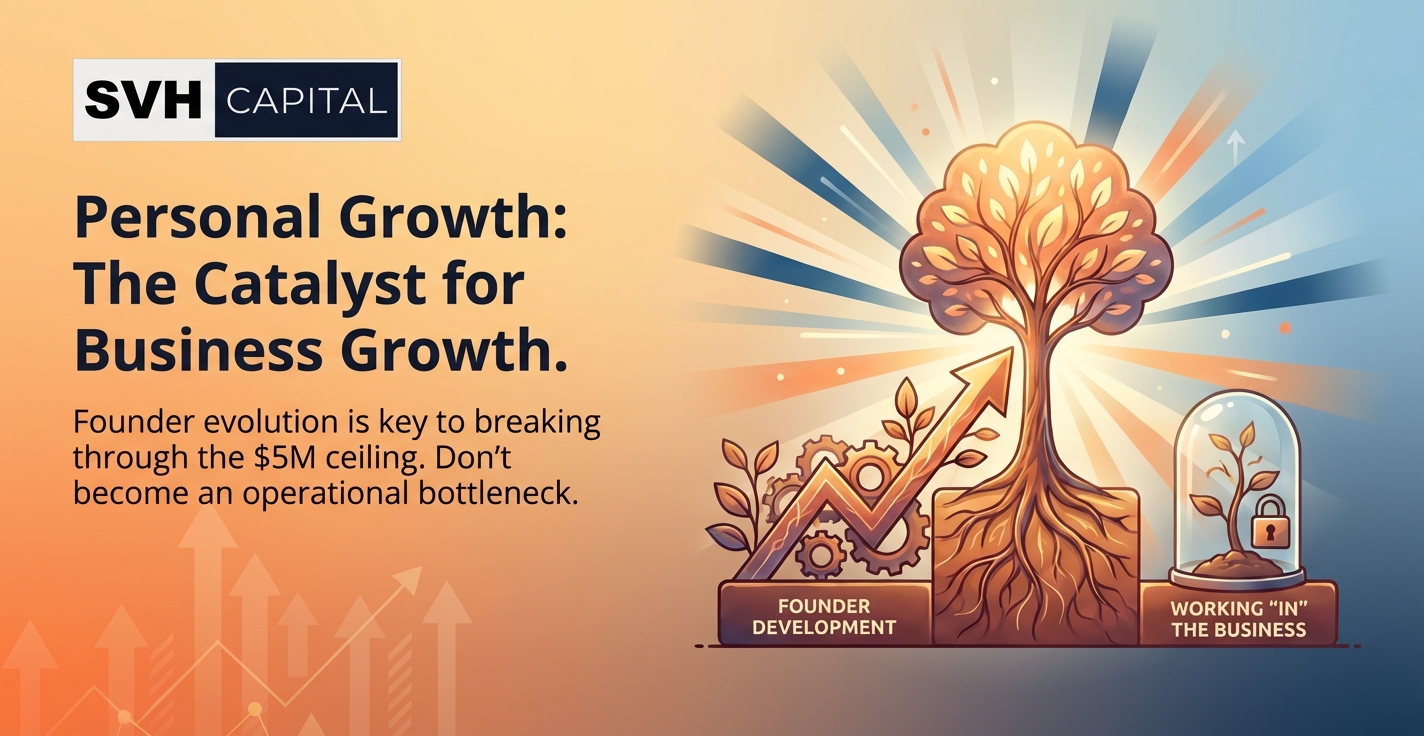
In the lower middle market, there is an invisible ceiling that many companies eventually encounter. This barrier is not always caused by a lack of capital, shifts in the market, or product flaws; often, the ceiling is the professional limit of the founder.
If you have built a profitable company over the last five years, you have already proven your ability to solve problems. You have survived the initial growth phases and reached the stability of the $5 million ARR mark. However, the skills required to reach this stage are often different from those needed to scale to $50 million.
To lead a maturing business effectively, a founder will proactively evolve. Success in this stage is frequently linked to a leader’s ability to bridge the learning gap through a structured professional development curriculum.
Personal Growth as a Catalyst for Business Growth
At the $5 million plus level, a business functions as a complex, living organism. In the early days, growth was driven by the founder’s direct output and relentless problem-solving. Today, the business’s potential is often tied to the leader’s professional evolution.
When a founder’s professional growth plateaus, the organization may experience a mindset mismatch. You might find yourself still working “in” the business, diving into projects or changing directions abruptly, rather than working “on” the business. This friction is a signal that a leadership style suitable for a smaller firm has reached its limit.
Continuous professional development is a strategic requirement for the long-term health of the enterprise. Without expanding your capacity to lead, a founder can become an operational bottleneck.
The Relationship Between Leader Development and Scaling
There is a significant correlation between a leader’s development and a company’s ability to scale.
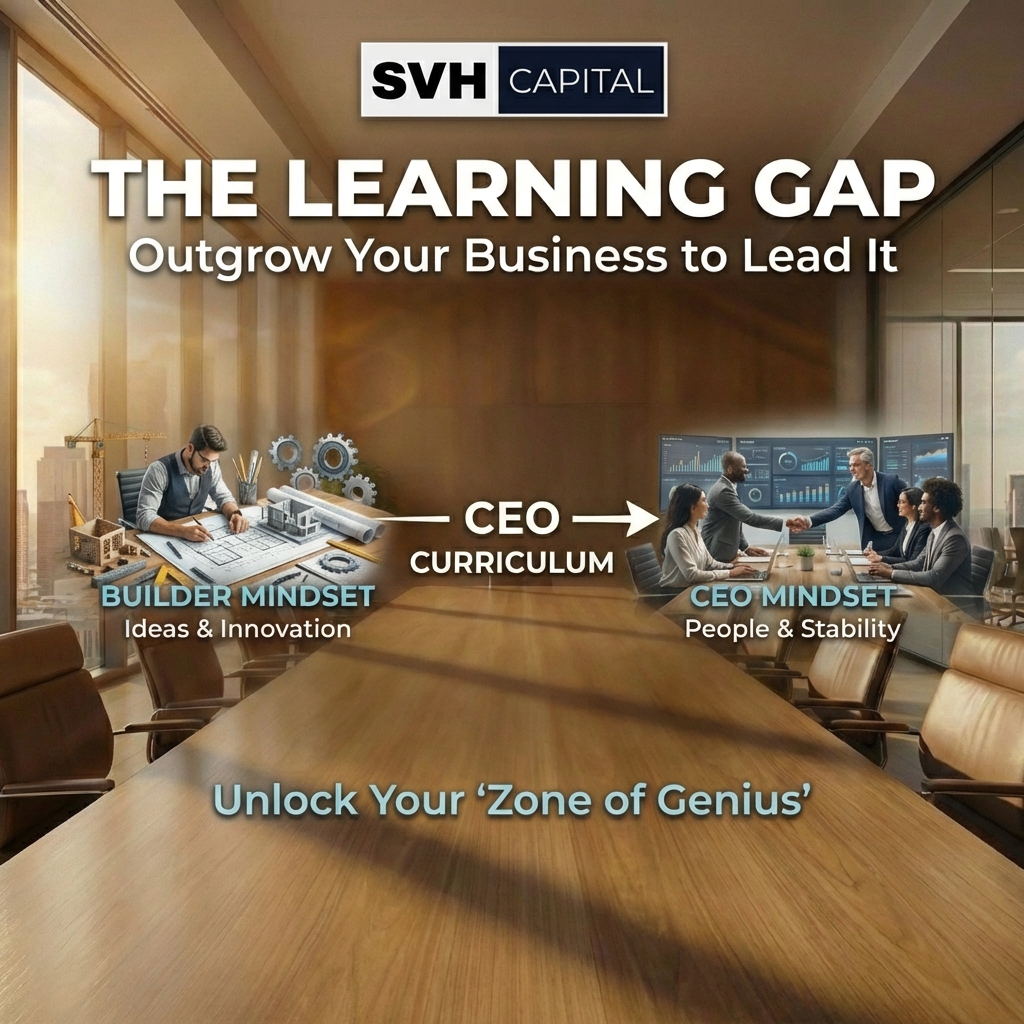
In a lower middle market company, management must transition from informal processes to a discipline of repeatable systems. This transition requires the founder to shift from a “Builder” mindset to a “CEO” mindset.
- The Builder: Focuses on ideas and seeks innovation.
- The CEO: Focuses on people and seeks operational stability.
If you feel drained by personnel management but energized by product development, you may be operating in a “Zone of Frustration”. Addressing this typically requires upskilling or delegation. Learning to delegate personnel management to qualified professionals allows a founder to return to their “Zone of Genius”: high-level strategy and business development.
Creating Your CEO Curriculum
Growth at this level is rarely accidental. It requires a structured plan designed to transition a founder from daily operations into a visionary leadership role. A curated professional curriculum should focus on three pillars:
Strategic Vision Over Execution
Learn to set the long-term direction of the firm without managing every tactical task. This involves mastering high-level Key Performance Indicators (KPIs) that allow you to monitor business health without micromanaging.
Building an Executive Team
A core skill for this stage is identifying and hiring an operator or “Integrator”. This transition allows the founder to stop acting as the Chief Operating Officer and start acting as a leader of leaders.
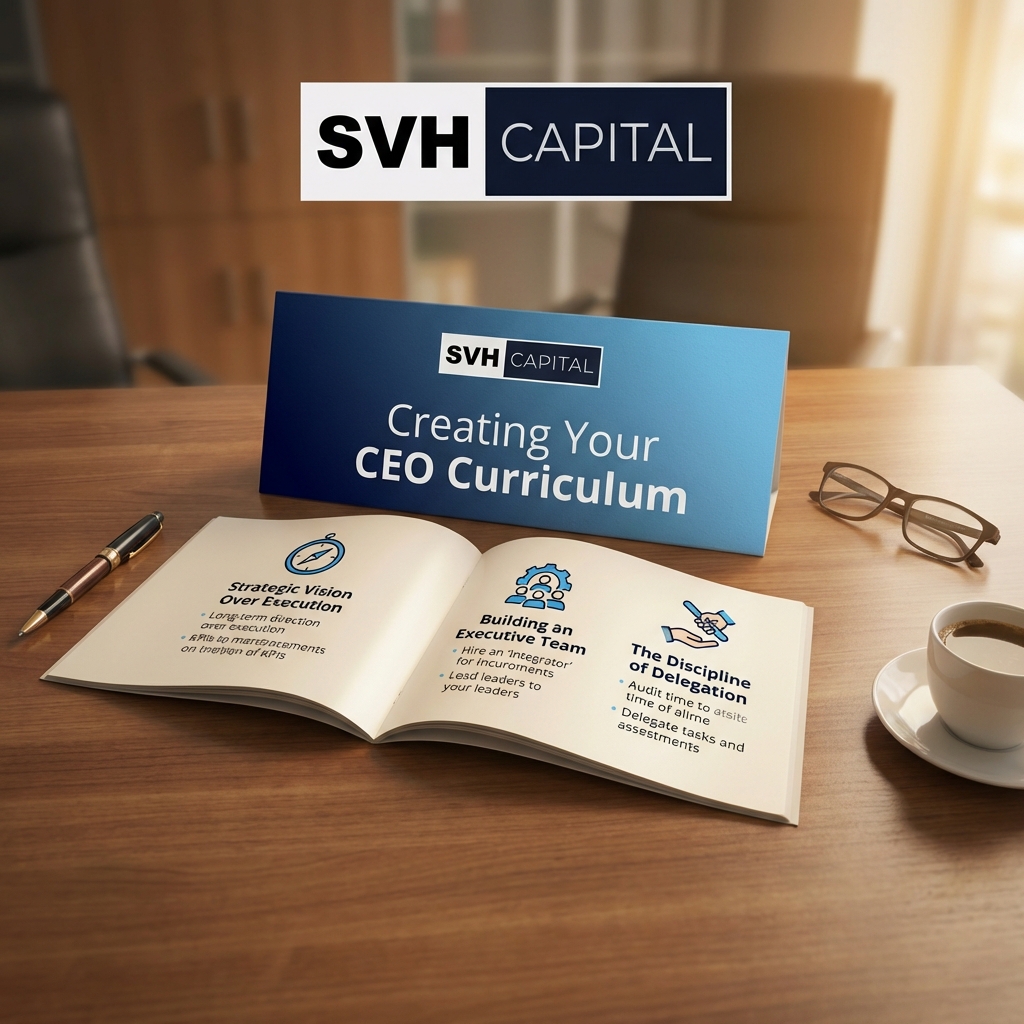
The Discipline of Delegation
An essential leadership skill is auditing how your time is allocated. If a significant portion of your week is spent on tasks that are outside your primary areas of expertise, it may represent a misallocation of leadership capital. A structured growth plan includes learning how to delegate tasks that no longer align with your specialized role.
The Bottom Line: Evolution is a Strategic Choice
Recognizing that you prefer building over daily management is an important milestone in leadership. It allows for the creation of a leadership structure that supports growth while protecting the founder’s professional passion.
Most founders started their businesses to create impact, not to become a prisoner of an organization chart. By committing to professional development and a CEO curriculum, you can help ensure you remain the leader your company requires for its next stage of growth
This material has been prepared for information and educational purposes only, and it is not intended to provide, nor should it be relied on for tax, legal, or investment advice. You should consult with your own tax, legal, and financial professionals for your specific situation. The views and opinions expressed in this article are those of the author and do not necessarily reflect the views or opinions of Finalis Securities, LLC. Securities offered through Finalis Securities LLC Member FINRA/SIPC. Silicon Valley Highpoint Capital and Finalis Securities LLC are separate, unaffliated entities.